
Tax11 min read
Thailand Corporate Tax Deadlines 2027: Full Filing Calendar
Every Thailand corporate tax deadline for 2027, month by month, plus what changes if the e-filing grace period ends.


How the 0%, 15% and 20% SME corporate tax rates work in Thailand, who qualifies and what you pay.
SME corporate tax in Thailand works on a sliding scale. A qualifying small company pays 0% on its first 300,000 THB of net profit and 15% on profit from 300,001 to 3 million THB. Only profit above 3 million THB is taxed at the standard 20%. This guide explains who qualifies, what the rates mean in baht and the mistakes that cost companies the reduced rate.
The standard corporate income tax rate in Thailand is 20% of net profit. Small companies that meet the SME conditions pay progressive rates instead, according to PwC's Thailand corporate tax summary:
Net profit (THB) | Tax rate |
|---|---|
0 to 300,000 | 0% |
300,001 to 3,000,000 | 15% |
Over 3,000,000 | 20% |
Each rate applies only to the slice of profit inside its band, the same way personal income tax works. A company with 1 million THB of profit does not pay 15% on the whole million. It pays nothing on the first 300,000 THB and 15% on the remaining 700,000 THB.
A Thai company or juristic partnership qualifies when it meets both of these conditions (PwC):
Paid-up capital of no more than 5 million THB at the end of the accounting period.
Income from selling goods and/or providing services of no more than 30 million THB.
The test is applied to each accounting period. If the company fails either condition for a year, the standard 20% rate applies to all of its profit for that year.
Two points that are easy to miss:
The capital test uses paid-up capital, not registered capital. What counts is the amount shareholders have actually paid in.
The income test refers to income from goods and services. If your company has other income, such as interest or a one-off asset sale, ask your accountant how it is treated in your case.
Net profit (THB) | Tax at SME rates | Tax at 20% | Saving |
|---|---|---|---|
250,000 | 0 | 50,000 | 50,000 |
1,000,000 | 105,000 | 200,000 | 95,000 |
5,000,000 | 805,000 | 1,000,000 | 195,000 |
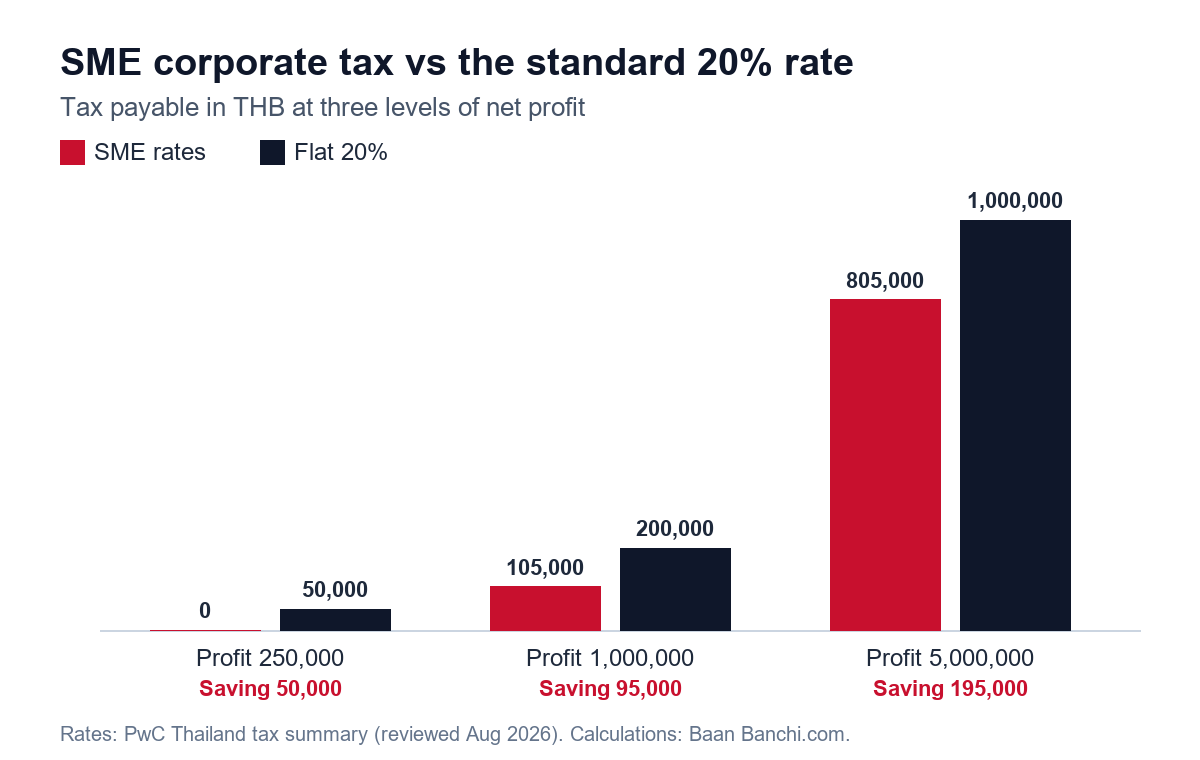
How the 5 million THB example is worked out: the first 300,000 THB is tax-free. The next 2,700,000 THB is taxed at 15% (405,000 THB) and the last 2,000,000 THB at 20% (400,000 THB). That gives a total of 805,000 THB.
Once profit passes 3 million THB, the saving stays at 195,000 THB a year, because only the first two bands are taxed below 20%. These examples use net taxable profit. Your taxable profit can be higher than your accounting profit once non-deductible expenses are added back.
Take a company with 1 million THB of net profit. As an SME it pays 105,000 THB. If it raises its paid-up capital to 6 million THB before the end of the year, it fails the capital test for that period. It then pays 200,000 THB instead: 95,000 THB more on the same profit.
So before you increase paid-up capital or sign a large contract near the year end, ask your accountant what it does to your tax rate for that year. The business reason may still win. It should be a decision, not a surprise.
Most companies pay corporate income tax twice a year. The half-year return (PND.51) is filed within two months after the first six months of the accounting period. For most companies, the tax is based on one-half of the estimated net profit for the full year. The annual return (PND.50) is due within 150 days of the year end (PwC tax administration summary). For the exact dates, see our Thailand corporate tax deadlines calendar.
Be careful with the half-year estimate. A company may underestimate its net profit by more than 25% of the actual full-year profit without a justifiable reason. In that case it is liable to a surcharge of 20% of the tax shortfall, as Forvis Mazars explains. An estimate based on up-to-date monthly accounts is the simplest protection.
Assuming the company still qualifies without checking paid-up capital and income at the year end.
Calculating the bands wrongly, for example applying 15% to all profit, or paying 20% on everything when the company qualifies for the SME rates.
Guessing the PND.51 estimate instead of basing it on current books, which risks the 20% surcharge.
Late or incomplete bookkeeping, so the year-end profit figure cannot be relied on. Our guide to bookkeeping in Thailand covers what the law requires.
Large differences between the tax return and the financial statements, one of the red flags that can lead to a tax audit.
0% on the first 300,000 THB of net profit, 15% on 300,001 to 3 million THB and 20% above 3 million THB. It applies to companies with paid-up capital of no more than 5 million THB and income from goods and services of no more than 30 million THB.
The rates depend on whether your company meets both conditions for the accounting period. Your accountant applies them when preparing the PND.51 and PND.50 returns.
The two published conditions look at paid-up capital and income, not at who owns the company. A company registered in Thailand is tested the same way whether its shareholders are Thai or foreign.
The saving grows with profit up to 3 million THB and then stays at 195,000 THB a year.
Yes. Our accounting services in Thailand include monthly bookkeeping, the half-year and annual corporate income tax returns and year-end financial statements, from 5,000 THB a month.
Not sure whether your company qualifies this year? Send us your figures and we will reply with a clear quote within one hour during office hours.
General information, not tax advice. Rates and conditions checked on 17 November 2026 against PwC's Thailand tax summary (last reviewed 24 August 2026).
Baan Banchi.com · Bangkok
Our team handles bookkeeping, tax filings, company registration and compliance for Thai and foreign-owned companies. Tell us what you need and we'll reply with a clear quote.
Every Thailand corporate tax deadline for 2027, month by month, plus what changes if the e-filing grace period ends.
The five red flags that lead to a tax audit in Thailand, and the monthly checks that keep you ready.
A practical guide to choosing an accounting company in Bangkok: Thai filings, questions to ask and fees.

